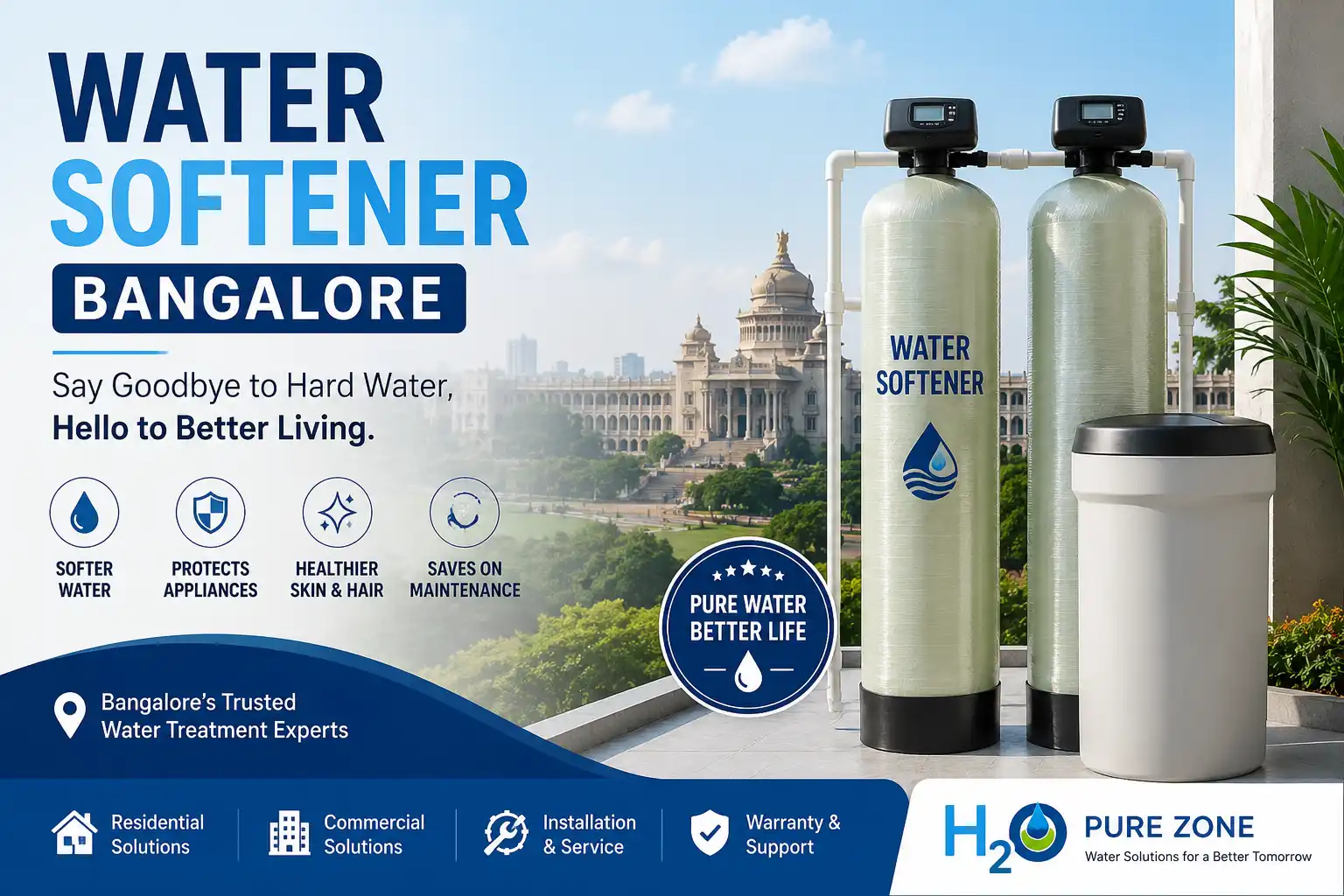
Water Softener Bangalore: The Complete Guide to Ending Hard Water Problems at Home & Work
Table of Contents
- Introduction
- What is Hard Water?
- What Causes Hard Water?
- Signs Your Home Has Hard Water
- Problems Caused by Hard Water
- What is a Water Softener?
- How Does a Water Softener Work?
- Types of Water Softeners
- Benefits of Installing a Water Softener
- Water Softener vs RO Water Purifier
- Which Homes and Businesses Need a Water Softener?
- Why Borewell Water Needs Softening
- How to Choose the Right Water Softener
- Installation Process
- Maintenance Guide
- Salt Refilling Guide
- Water Softener Cost Guide
- Local Hard Water Insights: Bangalore & Nearby Areas
- Why Choose H2O Pure Zone
- Customer FAQs
- Conclusion
Introduction
If you live in Bangalore and rely on borewell water, chances are you’ve already met the white, chalky residue that clings to your taps, the geyser that stopped heating as efficiently as it used to, or the shampoo that simply refuses to lather no matter how much you use. These aren’t random plumbing quirks — they’re classic symptoms of hard water, and they are extremely common across Bangalore’s residential and commercial properties.
A water softener in Bangalore isn’t a luxury appliance anymore. For most homes running on borewell water — which is the majority of the city outside core Cauvery-supplied zones — it’s becoming a practical necessity. Hard water doesn’t just look unpleasant; it quietly shortens the life of your geyser, washing machine, and plumbing, while making everyday tasks like bathing, washing clothes, and cleaning dishes noticeably harder.
This guide walks you through everything you need to know: what hard water actually is, why it’s so widespread in Bangalore and surrounding areas like Electronic City, Jigani, Bommasandra, and Sarjapur, how water softeners work, the types available, how they compare to RO purifiers, and how to choose the right system for your home, apartment, villa, or business. Whether you’re dealing with a single household tap or managing water quality across a hotel, hospital, school, or factory, this article will help you make an informed decision — and show you why H2O Pure Zone is a trusted water softener dealer in Bangalore for installation, service, and long-term maintenance.
What is Hard Water?
Hard water is water that contains a high concentration of dissolved minerals — primarily calcium and magnesium — picked up as water passes through rock, soil, and mineral deposits underground. The more calcium and magnesium present, the “harder” the water is considered to be.
Water hardness is typically measured in terms of the concentration of these minerals, often expressed as parts per million (ppm) or grains per gallon (GPG). Water quality guidelines from recognized public health and water resource organizations classify water hardness into general ranges — from soft to moderately hard to very hard — and Bangalore’s groundwater frequently falls into the moderately hard to very hard categories, particularly in areas dependent on borewells.
Hard water isn’t necessarily unsafe to drink from a basic health standpoint, but it creates a long list of practical, cosmetic, and infrastructure problems that affect nearly every part of a household or commercial property that touches water — plumbing, appliances, skin, hair, and even your electricity bill.
What Causes Hard Water?
Hard water forms naturally through a simple geological process, but several factors make it especially prevalent in Bangalore:
- Groundwater dependency: A large share of Bangalore’s water supply — especially in peripheral and rapidly developing areas — comes from borewells rather than the Cauvery river network. Groundwater travels through mineral-rich rock layers, especially granite and limestone formations common in the Deccan Plateau region, picking up calcium and magnesium along the way.
- Geology of the region: Bangalore sits on hard rock terrain, and as water percolates through these layers over years, it dissolves mineral content, which then ends up in the water drawn from borewells.
- Falling water tables: As borewells are dug deeper to reach water, the water often passes through more mineral-dense rock layers, which can increase hardness.
- Seasonal variation: Hardness levels can fluctuate depending on rainfall and recharge patterns, since diluted rainwater recharge can temporarily reduce concentration, while dry spells tend to concentrate minerals further.
- Urban development pressure: As new layouts, apartment complexes, and gated communities are developed on the outskirts of the city, many rely entirely on newly dug borewells with no treatment infrastructure, making hard water issues immediately apparent to new residents.
This is why hard water complaints are so consistently reported by residents across Bangalore’s newer residential corridors, and why testing your specific water source is the only way to know your exact hardness level.
Signs Your Home Has Hard Water
You don’t need a laboratory to suspect hard water — your home usually tells you first. Common signs include:
- White or chalky scale buildup around taps, showerheads, and faucet aerators
- A dull, gritty film on glassware and utensils even after washing
- Soap and shampoo that don’t lather easily, requiring more product for the same result
- A slippery-yet-not-quite-clean feeling on skin after bathing
- Clothes that feel stiff, rough, or fade faster than expected after washing
- Spots and streaks on dishes and cutlery after a dishwasher cycle
- Reduced water pressure over time, especially in older pipe networks
- Frequent geyser element failures or reduced heating efficiency
- A visible “kettle scale” layer when boiling water
- Bathroom tiles and glass shower doors that look permanently hazy despite cleaning
If several of these sound familiar, hard water testing is the logical next step before deciding on a treatment solution.
Problems Caused by Hard Water
Hard water’s effects go far beyond cosmetic annoyance. Over months and years, the cumulative damage can be significant:
Bathroom Stains
Calcium and magnesium deposits create stubborn white or yellowish stains on tiles, wash basins, faucets, and glass shower partitions that resist regular cleaning agents.
White Scale Deposits
Limescale builds up inside pipes, faucets, and shower heads, gradually restricting flow and requiring more frequent cleaning or replacement of fittings.
Damaged Geysers
Scale buildup on heating elements forces geysers to work harder to heat the same volume of water, leading to premature element burnout and reduced lifespan — one of the most expensive hard water side effects homeowners face.
Pipe Blockage
Mineral scale accumulates inside pipework over time, narrowing the internal diameter and reducing water pressure throughout the home.
Skin Irritation
Hard water can leave a mineral film on skin that disrupts the natural moisture barrier, often leading to dryness, itchiness, or irritation, especially for those with sensitive skin or eczema.
Hair Fall
Mineral deposits can coat hair strands, making them feel rough, weighed down, and more prone to breakage — a common complaint among long-term hard water users.
Soap Not Lathering
Calcium and magnesium ions react with soap to form a sticky scum instead of a proper lather, meaning you use more soap and shampoo for the same cleaning result.
Reduced Appliance Life
Washing machines, dishwashers, and geysers all suffer reduced operational lifespans when scale builds up on internal heating elements and components.
High Electricity Bills
Scale acts as an insulating layer on heating elements, meaning appliances like geysers need more energy and time to heat water — directly increasing electricity consumption over time.
Quick Tip: If your geyser’s heating time has noticeably increased over the past year, hard water scaling on the heating element is one of the most common culprits.
What is a Water Softener?
A water softener is a treatment system designed specifically to remove hardness-causing minerals — mainly calcium and magnesium — from your water supply. Unlike purifiers, which focus on removing contaminants, pathogens, or dissolved solids for drinking safety, a water softener’s core job is to protect your plumbing, appliances, skin, and hair from the physical and chemical effects of mineral-rich water.
Water softeners are typically installed at the point where water enters the home or building (point-of-entry), treating all the water used across bathrooms, kitchens, laundry, and other outlets — which is why they’re often called whole house water softeners.
How Does a Water Softener Work?
Most residential and commercial water softeners use a process called ion exchange, and while it sounds technical, the concept is simple:
- Hard water enters the softener tank, which is filled with thousands of tiny resin beads.
- These resin beads carry a negative charge and are coated with sodium (or potassium) ions.
- As hard water flows through the resin bed, the positively charged calcium and magnesium ions in the water are attracted to the resin beads and swap places with the sodium ions — this “swap” is the ion exchange.
- The calcium and magnesium stay trapped on the resin, while softened water — now carrying a small amount of sodium instead — flows out to your taps.
- Over time, the resin becomes saturated with calcium and magnesium and needs to be “recharged.” This happens through a regeneration cycle, where a concentrated salt (brine) solution flushes through the resin bed.
- The brine solution replaces the trapped calcium and magnesium with fresh sodium ions, restoring the resin’s softening capacity, while the displaced hardness minerals are flushed out as wastewater.
- Modern automatic softeners handle this regeneration cycle on their own, based on a timer or the volume of water used, so homeowners don’t need to manage it manually.
Think of the resin bed as a sponge that swaps “hard” minerals for a “soft” one (sodium), and the salt brine as the tool that wrings the sponge out and gets it ready to work again.
Types of Water Softeners
There are several types of water softeners available, each suited to different needs, budgets, and water usage patterns.
| Type | How It Works | Best For | Pros | Cons |
|---|---|---|---|---|
| Salt-Based (Ion Exchange) Softener | Uses resin beads and salt brine regeneration to remove calcium and magnesium | Homes and businesses with moderate to very hard water | Highly effective, proven technology, handles high hardness levels well | Requires regular salt refilling, produces some wastewater during regeneration |
| Salt-Free Water Conditioner | Alters mineral structure (crystallization) rather than removing minerals | Areas with lower hardness or where sodium addition is undesirable | No salt handling, no wastewater discharge | Does not truly remove hardness minerals, less effective on very hard water |
| Dual-Tank Softener | Two resin tanks alternate, so one regenerates while the other supplies water | Large families, commercial properties, continuous water demand | Uninterrupted soft water supply even during regeneration | Higher upfront cost, larger installation footprint |
| Single-Tank Automatic Softener | One resin tank with automatic timer or metered regeneration | Most residential homes, apartments, villas | Cost-effective, compact, low maintenance | Brief downtime during regeneration cycle |
| Portable/Compact Softener | Small-capacity unit for limited installation space | Apartments, smaller households, point-of-use needs | Space-saving, easier installation | Lower capacity, more frequent regeneration needed |
| Commercial/Industrial Softener | High-capacity multi-tank systems with advanced controls | Hotels, hospitals, schools, factories, large residential complexes | Handles high volume and continuous demand | Higher investment, needs professional sizing and maintenance planning |
Highlighted Tip: For most independent houses and villas in Bangalore using borewell water, a single-tank automatic salt-based softener with the correct capacity for your household size is usually the most practical and cost-effective choice.
Benefits of Installing a Water Softener
- Longer appliance life — geysers, washing machines, and dishwashers experience less scale-related wear
- Softer skin and hair — no more mineral film sitting on your skin after a bath
- Better lather with less soap and shampoo — cleaner rinsing, less product wasted
- Spot-free dishes and glassware — no more cloudy water marks after washing
- Brighter, longer-lasting clothes — less mineral buildup in fabric fibers during laundry
- Cleaner bathroom fixtures — significantly reduced scale buildup on tiles, taps, and glass
- Improved water heater efficiency — less scale on heating elements means less energy needed for the same water temperature
- Reduced plumbing maintenance — less mineral buildup inside pipes over the long term
- Better overall comfort — a noticeably different bathing and cleaning experience, especially for households that have lived with hard water for years
Water Softener vs RO Water Purifier
This is one of the most common points of confusion for homeowners. The two systems solve different problems and are often used together, not as substitutes for each other.
| Feature | Water Softener | RO Water Purifier |
|---|---|---|
| Primary Purpose | Removes hardness minerals (calcium, magnesium) to protect plumbing, appliances, skin, and hair | Removes dissolved solids, contaminants, and impurities to make water safe for drinking |
| Treatment Point | Point-of-entry (whole house) | Point-of-use (usually kitchen tap, for drinking/cooking water) |
| What It Removes | Calcium, magnesium, some hardness-related minerals | Dissolved salts, heavy metals, bacteria, and other contaminants depending on membrane and filter stages |
| Effect on Taste | Minimal direct effect on drinking taste | Directly improves taste and safety of drinking water |
| Water Wastage | Some water used during regeneration cycle | RO systems typically reject a portion of input water as wastewater |
| Impact on Appliances | Major positive impact — reduces scale in geysers, machines, pipes | No impact on whole-house plumbing or appliances |
| Sodium Content | Slightly increases sodium in treated water (salt-based systems) | Reduces dissolved solids, including sodium, depending on TDS levels |
| Ideal Use Case | Whole-house protection against hard water damage | Safe, great-tasting drinking and cooking water |
| Can They Work Together? | Yes — softened water can be fed into an RO system for even better purifier performance and longer filter life | Yes — many homes use a softener for the whole house and an RO purifier at the kitchen tap |
Key Takeaway: A water softener protects your home’s infrastructure and improves everyday water use across every tap. An RO purifier makes your drinking water safe and better tasting. For hard borewell water, using both together often gives the best results — softened water can also extend the life of your RO membrane by reducing scale buildup inside the purifier itself.
Which Homes and Businesses Need a Water Softener?
Apartments
Apartment complexes relying on shared borewell supply often have consistently hard water across all units. A whole-house or centralized softening solution can benefit residents dealing with recurring appliance issues and skin/hair complaints.
Villas
Independent villas, especially in gated communities on Bangalore’s outskirts, typically draw water directly from private borewells — making them strong candidates for a dedicated residential water softener.
Individual Houses
Standalone homes with their own borewell connection are among the most common water softener customers, since there’s no municipal treatment step involved before the water reaches their taps.
Borewell Water Users
If your primary water source is a borewell — rather than Cauvery-supplied municipal water — hardness levels are typically higher, making softening especially relevant.
Hotels
Guest-facing hospitality businesses benefit from softened water for cleaner linens, spot-free glassware, better guest bathing experience, and protection of expensive plumbing and hot water systems.
Hospitals
Hospitals often require consistent water quality for equipment sterilization, laundry, and patient care areas, making commercial-grade softening systems valuable for operational reliability.
Schools
Educational institutions with large-scale water usage across restrooms, kitchens, and hostels can see meaningful reductions in plumbing maintenance costs with proper softening.
Factories
Industrial operations that use water in boilers, cooling systems, or production processes often need softened water to prevent scale-related equipment inefficiency and downtime.
Restaurants
Commercial kitchens benefit from softened water for dishwashing, cooking equipment longevity, and consistent water quality for food preparation processes.
Why Borewell Water Needs Softening
Borewell water is drawn directly from underground aquifers, without the treatment processes applied to surface water supplied through municipal networks. As this water travels through rock and soil layers — particularly the granite-heavy geology common across Bangalore and surrounding areas — it naturally dissolves calcium, magnesium, and other minerals along the way.
Because there’s no centralized treatment step before this water reaches your home, any hardness present in the source will flow directly into your taps, geysers, and appliances. This is precisely why water softeners for borewell water are such a common and practical investment for homes and businesses across Bangalore’s borewell-dependent zones — they act as the treatment step that would otherwise be missing entirely.
How to Choose the Right Water Softener
Selecting the right water softener depends on several factors specific to your property:
- Water Hardness Level — A professional hard water test tells you exactly how hard your water is, which determines the resin capacity and regeneration frequency you’ll need.
- Daily Water Consumption — Family size and daily usage patterns (number of bathrooms, laundry frequency, etc.) determine the required flow rate and tank capacity.
- Available Installation Space — Softeners need a dedicated space near the water inlet point; apartments may need more compact units compared to independent villas.
- Single vs Dual Tank — Continuous large-volume users (commercial properties, big families) may benefit from dual-tank systems that never interrupt supply during regeneration.
- Automatic vs Manual Regeneration — Automatic, metered systems are more convenient and efficient for most households, adjusting regeneration based on actual water usage rather than a fixed timer.
- Budget and Long-Term Running Costs — Consider not just the upfront cost, but ongoing salt refilling and maintenance requirements.
- Property Type — Apartments, villas, individual homes, and commercial buildings each have different practical installation and capacity considerations.
Highlighted Tip: Never choose a water softener size based on guesswork. An undersized unit will regenerate too frequently and wear out faster, while an oversized unit adds unnecessary upfront cost. A proper water hardness test and household usage assessment should always guide the decision.
Installation Process
A professional water softener installation typically follows these steps:
- Site Visit & Water Testing — A technician tests your water hardness and assesses your plumbing layout, water pressure, and installation space.
- System Recommendation — Based on hardness levels and household/commercial usage, the right softener type and capacity are recommended.
- Installation Point Selection — The softener is typically installed at the main water inlet, ensuring all outlets receive softened water (whole-house treatment).
- Bypass Valve Setup — A bypass valve is installed so water can be diverted around the softener during maintenance without disrupting the entire water supply.
- Plumbing Connection — The unit is connected to the incoming water line, with proper sealing and pressure testing to prevent leaks.
- Drain Line Connection — A drain line is set up for the regeneration wastewater discharge.
- Salt Tank Setup & Initial Charging — The brine tank is filled with salt, and the system undergoes its first regeneration cycle to activate the resin.
- Testing & Handover — Water output is tested for softness, the system’s automatic settings are configured, and the homeowner is guided through basic operation and maintenance.
Maintenance Guide
Regular maintenance keeps your water softener performing at its best for years:
- Check salt levels monthly and refill before the tank runs completely empty
- Inspect the brine tank periodically for salt bridging (a hardened salt crust) or mushing (a thick sludge at the tank bottom)
- Clean the resin bed periodically, especially if your water supply has sediment or iron content
- Check for leaks at all pipe connections and valves during routine inspection
- Test water softness periodically to confirm the system is performing as expected
- Service the control valve and timer/metering system as part of an annual maintenance visit
- Schedule a professional AMC (Annual Maintenance Contract) visit at least once or twice a year to catch small issues before they become costly repairs
Salt Refilling Guide
Salt is the fuel your softener uses to regenerate its resin bed, so keeping the brine tank properly filled is one of the simplest but most important maintenance tasks:
- Check salt levels at least once a month, more frequently for larger households or commercial systems with heavy usage
- Keep the tank at least one-quarter to one-third full at all times — never let it run completely empty
- Use good-quality softener-grade salt (such as pellet or granular salt designed for water softeners) rather than ordinary table salt or rock salt, which can introduce impurities
- Avoid overfilling — leave adequate space at the top of the brine tank as recommended by your system’s manual
- Watch for salt bridging — a hardened crust that forms above the water level, creating an empty space below; this can trick the system into thinking there’s more salt than there actually is, requiring manual breaking up
- Keep the tank lid closed to prevent dust, debris, or insects from contaminating the salt
Water Softener Cost Guide
Water softener pricing varies significantly based on several factors, so it’s important to understand what drives the cost rather than expecting a single fixed number:
- Water Hardness Level — Harder water may require higher-capacity resin and more frequent regeneration, affecting system sizing and cost.
- Family Size / Daily Water Usage — Larger households or commercial properties need higher-capacity systems to meet daily demand without excessive regeneration cycles.
- Tank Capacity — Resin tank size and brine tank size are selected based on hardness level and usage volume, directly influencing price.
- Single Tank vs Dual Tank Systems — Dual-tank systems that provide continuous softened water typically cost more than single-tank units.
- Installation Complexity — Plumbing layout, distance from the main inlet, drain line accessibility, and available space can all affect installation costs.
- Brand and Build Quality — Component quality, valve technology (timer-based vs metered/automatic), and warranty terms vary across manufacturers.
- Additional Requirements — Bypass valves, additional fittings, or integration with existing RO systems can add to the overall project cost.
Because every property’s water hardness, usage pattern, and installation requirements are different, the most reliable way to get an accurate cost estimate is through a free water testing and site assessment — which H2O Pure Zone offers as the first step for every new inquiry.
Local Hard Water Insights: Bangalore & Nearby Areas
Hard water conditions can vary meaningfully across Bangalore and its surrounding growth corridors, largely due to differences in groundwater depth, local geology, and how heavily an area relies on borewells versus municipal supply. Here’s what residents and businesses across key areas should know:
Bangalore
As Bangalore’s urban core continues to expand, many newer residential layouts and apartment complexes depend heavily on borewell water rather than Cauvery supply, making hard water testing a useful first step for households noticing scale buildup or appliance issues.
Electronic City
As a major residential and commercial hub with a large concentration of apartments, tech park facilities, and individual homes, Electronic City residents relying on borewell connections often report the classic signs of hard water — from geyser scaling to soap lather issues.
Jigani
Jigani’s growing residential and industrial presence means many properties — including factories and warehouses — depend on borewell water, where softening can help protect both domestic plumbing and industrial equipment from scale-related wear.
Bommasandra
With its mix of residential layouts and industrial estates, Bommasandra properties often face hard water challenges tied to borewell dependency, making both residential and commercial water softening relevant for the area.
Harohalli
As an emerging industrial and residential zone on Bangalore’s southern outskirts, Harohalli’s borewell-reliant properties can benefit from water softening to protect newly installed plumbing and appliances from early scale damage.
Anekal
Anekal’s mix of villas, individual houses, and smaller residential developments frequently rely on private borewells, where testing water hardness before appliance installation can help avoid premature wear.
Bannerghatta Road
This corridor’s dense residential and commercial development, combined with borewell dependency in many buildings, makes hard water awareness particularly relevant for apartment associations and independent homeowners alike.
Sarjapur
Sarjapur’s rapid growth in gated communities and villa layouts has brought many new residents face-to-face with hard water issues for the first time, especially those unfamiliar with borewell-supplied properties.
Attibele
As a residential and industrial belt near the Tamil Nadu border, Attibele properties — from homes to small factories — often depend on borewell water, where softening can support both domestic comfort and equipment longevity.
Chandapura
Chandapura’s expanding residential footprint, largely served by borewell connections, means many households are encountering hard water concerns as they settle into newer properties.
Hosur Road
This major residential and commercial corridor sees a significant share of properties relying on private borewells, making water hardness testing a practical first step for both homeowners and business owners along the stretch.
Note: Hard water severity can vary even within the same locality depending on borewell depth and local groundwater conditions. The only reliable way to know your exact hardness level is a proper water test at your specific property — which H2O Pure Zone provides as part of every consultation.
Why Choose H2O Pure Zone
H2O Pure Zone has built its reputation on providing dependable, professionally installed water treatment solutions across Bangalore and surrounding areas. Here’s what sets us apart:
✔ Expert Installation — Our technicians follow a structured installation process, ensuring correct sizing, proper plumbing integration, and long-term system reliability.
✔ Professional Water Testing — Every consultation begins with an accurate hardness assessment, so you get a solution matched to your actual water conditions — not guesswork.
✔ Genuine Products — We supply and install reliable water softener systems built for real-world Bangalore water conditions.
✔ Annual Maintenance Contracts (AMC) — Our AMC plans keep your system performing at its best year-round, with scheduled servicing and priority support.
✔ Fast Service — From initial inquiry to installation and ongoing support, we prioritize quick response times across our service areas.
✔ Experienced Technicians — Our team brings hands-on expertise in water softener installation, repair, and maintenance across residential and commercial properties.
✔ Affordable Pricing — We provide transparent, fair pricing based on your actual requirements, with no hidden costs.
✔ Customer Support — Ongoing support for troubleshooting, salt refilling guidance, and system servicing whenever you need it.
✔ Coverage Across Bangalore & Nearby Areas — We proudly serve Bangalore, Jigani, Bommasandra, Electronic City, Harohalli, Anekal, Bannerghatta Road, Sarjapur, Attibele, Chandapura, Hosur Road, and surrounding communities.
Whether you’re a homeowner tired of scale-covered taps, an apartment association looking for a centralized solution, or a business owner managing water quality for guests, patients, students, or production processes — H2O Pure Zone is ready to help with a solution built around your specific water conditions.
Customer FAQs
1. How do I know if I have hard water at home?
Common signs include white scale on taps and showerheads, soap not lathering well, stiff laundry, and reduced geyser efficiency. A professional water hardness test gives you a definitive answer.
2. Is hard water safe to drink?
Hard water is generally not considered a direct health hazard at typical hardness levels, but it does affect taste, cause scale buildup, and can lead to skin and hair issues with prolonged use.
3. What’s the difference between a water softener and a water purifier?
A water softener removes hardness minerals (calcium and magnesium) to protect plumbing and appliances, while a water purifier (like RO) removes contaminants to make water safe for drinking.
4. Do I need both a water softener and an RO purifier?
Many homes with hard borewell water use both — a whole-house softener for general use, and an RO purifier at the kitchen tap for safe drinking water. Softened water can also extend your RO membrane’s lifespan.
5. How long does a water softener installation take?
Installation timelines vary based on plumbing complexity and system type, but most residential installations are completed within a single day by an experienced technician.
6. How often do I need to refill the salt in my water softener?
This depends on your household’s water usage and hardness level, but checking salt levels monthly is a good general practice.
7. What type of salt should I use in my water softener?
Softener-grade pellet or granular salt is recommended, rather than table salt or rock salt, to avoid introducing impurities into the system.
8. Can a water softener help with borewell water in Bangalore?
Yes — borewell water is a common source of hardness in Bangalore due to local geology, and a properly sized softener can significantly reduce hardness-related problems.
9. Will a water softener increase my electricity bill?
No — in fact, by reducing scale buildup on geyser heating elements, a softener can improve heating efficiency and potentially reduce electricity usage over time.
10. How much space do I need for a water softener installation?
Space requirements vary by system size, but most residential units are compact enough to fit near the main water inlet point, utility area, or basement.
11. Can water softeners be installed in apartments?
Yes — apartments can use either compact individual units or centralized solutions depending on the building’s plumbing setup and association preferences.
12. Do commercial properties like hotels and hospitals need special water softeners?
Yes — commercial and industrial properties typically require higher-capacity systems designed for continuous, high-volume water demand.
13. How do I maintain my water softener?
Regular salt refilling, periodic resin bed checks, leak inspections, and an annual professional service visit are the core maintenance requirements.
14. What is an AMC (Annual Maintenance Contract) for water softeners?
An AMC is a service agreement that covers scheduled maintenance visits, ensuring your softener continues to perform reliably without unexpected breakdowns.
15. How long does a water softener typically last?
With proper maintenance, water softeners can provide many years of reliable service, though the resin bed and components may eventually need replacement depending on usage and water quality.
16. Does H2O Pure Zone provide free water testing?
Yes — H2O Pure Zone offers professional water hardness testing as part of the initial consultation process.
17. What areas does H2O Pure Zone serve?
We serve Bangalore, Jigani, Bommasandra, Electronic City, Harohalli, Anekal, Bannerghatta Road, Sarjapur, Attibele, Chandapura, Hosur Road, and nearby areas.
18. How is water softener pricing determined?
Pricing depends on water hardness level, household or commercial usage, tank capacity, and installation requirements — which is why a site assessment is the best way to get an accurate quote.
19. Can a water softener fix low water pressure caused by scale buildup?
A softener prevents further scale buildup in pipes, which helps maintain water pressure over time, though existing severe blockages may require separate plumbing attention.
20. What should I do if my water softener stops working properly?
Contact a professional technician for a diagnostic check — common issues include salt bridging, resin depletion, or valve malfunctions, all of which can typically be resolved with proper servicing.
21. Is a water softener a one-time installation, or does it need ongoing servicing?
While installation is a one-time process, ongoing servicing (salt refilling, periodic maintenance, and occasional part replacement) is necessary to keep the system performing effectively over the years.
22. Can I get a water softener installed specifically for villa or independent house borewell water?
Yes — villas and independent houses with private borewells are among the most common and suitable candidates for a dedicated residential water softener system.
Conclusion
Hard water is one of those problems that creeps up slowly — a little more soap needed here, a slightly less efficient geyser there — until one day you realize your bathroom fixtures, appliances, skin, and hair have all been quietly paying the price for years. Across Bangalore and nearby areas like Electronic City, Jigani, Bommasandra, Harohalli, Anekal, Bannerghatta Road, Sarjapur, Attibele, Chandapura, and Hosur Road, borewell-dependent homes and businesses are especially likely to be affected.
The good news is that this is a solvable problem. A properly sized, professionally installed water softener in Bangalore can protect your plumbing and appliances, improve your everyday bathing and cleaning experience, and reduce long-term maintenance costs — whether you’re a homeowner, apartment resident, villa owner, or running a hotel, hospital, school, restaurant, or factory.
Ready to stop hard water damage before it gets worse? Contact H2O Pure Zone today for a free water hardness test and expert consultation. Our team will assess your specific water conditions and recommend the right water softener solution for your home or business — with expert installation, genuine products, and reliable ongoing support across Bangalore and surrounding areas.
Our Projects Installation Gallery