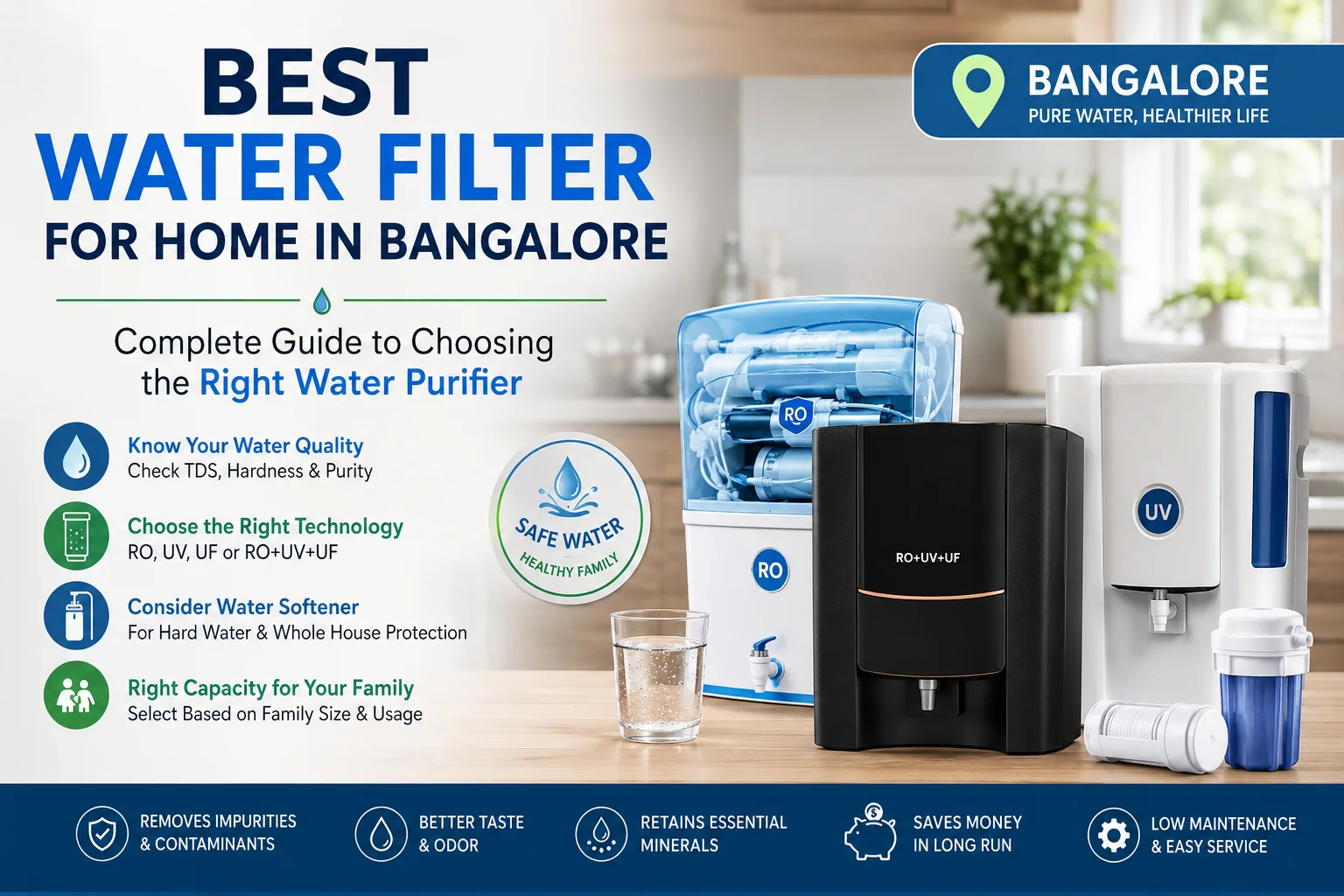
Best Water Filter for Home in Bangalore: Complete Guide to Choosing the Right Water Purifier
Choosing the best water filter for your home in Bangalore can be confusing because water quality varies significantly from one locality to another. Some homes receive treated Cauvery water, while many apartments and independent houses depend on borewell or tanker water.
The right water purifier should therefore be selected based on your water source, TDS level, hardness, microbial contamination, family size, and daily water consumption—not simply by choosing the most expensive RO purifier.
In this guide, we explain how to choose the best water purifier for your home in Bangalore, including RO, UV, UF, water softeners, storage capacity, maintenance, and important features to consider.
Why Water Purification Is Important in Bangalore
Bangalore receives water from different sources, including municipal/Cauvery supply, borewells and private water tankers. These sources can have very different characteristics.
Groundwater quality can also vary depending on location, depth and seasonal conditions. Recent research on groundwater around Bengaluru highlights the impact of urbanization and changing land use on groundwater quality.
For this reason, a purifier that works well in one Bangalore locality may not be the ideal choice for another.
The first step should always be to test your home’s actual water quality.
What Should You Check Before Buying a Water Purifier?
Before purchasing a water filter, check these important parameters:
- Water source
- TDS level
- Water hardness
- Turbidity
- Microbial contamination
- Iron and other dissolved contaminants
- Daily water consumption
- Available installation space
- Maintenance and filter replacement cost
1. Check Your Water Source
Identify where your household water comes from.
Cauvery or municipal water:
Generally, this water has already undergone treatment, but additional purification may still be desirable depending on the quality at your home and the condition of the storage tanks and plumbing.
Borewell water:
Borewell water can contain higher levels of dissolved minerals and hardness. In such cases, an RO system may be appropriate, depending on the actual water test.
Tanker water:
The quality can vary depending on the source and handling of the water. Testing is particularly important if tanker water is your primary drinking-water source.
2. Test the TDS Level
TDS, or Total Dissolved Solids, represents dissolved substances such as salts and minerals in water. BIS materials identify 500 mg/L as the desirable TDS limit for drinking water under the relevant standard, with higher permissible levels under specified conditions.
A simple TDS test can help determine whether RO is necessary.
However, TDS alone does not tell you whether water is safe to drink. It does not identify every contaminant or microbial risk.
A Practical Purifier Guide
| Water Condition | Commonly Suitable Technology |
|---|---|
| Relatively low TDS municipal water | UV / UF / UV+UF |
| Moderate TDS with microbial concerns | UV+UF or suitable RO system |
| High-TDS borewell water | RO+UV/UF |
| Hard water used throughout the house | Water softener + drinking-water purifier |
| High turbidity or sediment | Sediment filtration before the main purifier |
The final choice should be based on a proper water-quality test rather than TDS alone.
RO vs UV vs UF: Which Is Best?
Understanding purification technologies makes choosing the right water filter much easier.
RO Water Purifier
Reverse Osmosis (RO) uses a semi-permeable membrane to reduce many dissolved substances from water.
RO is particularly useful when your home’s water has high TDS or dissolved contaminants.
A typical RO system may include:
- Sediment filter
- Pre-carbon filter
- RO membrane
- UV or UF stage
- Post-carbon filter
- Mineralizer or remineralization stage
If your home uses high-TDS borewell or tanker water, an RO water purifier for Bangalore homes can be a suitable choice after testing the water.
UV Water Purifier
Ultraviolet (UV) purification uses UV light to inactivate microorganisms.
UV is useful when microbial protection is required but there is no need to significantly reduce dissolved minerals.
For relatively low-TDS municipal water, UV-based purification can be a practical option.
UF Water Purifier
Ultrafiltration (UF) uses a membrane to remove suspended particles and certain microorganisms.
UF does not work like RO for reducing dissolved salts and TDS.
RO + UV + UF
For households dealing with more complex water-quality conditions, an RO + UV + UF water purifier can provide multiple purification stages.
This type of system is particularly useful when both dissolved contaminants and microbial contamination are concerns.
Do You Need a Water Softener in Bangalore?
A water purifier and a water softener solve different problems.
A water softener is primarily designed to reduce hardness-causing minerals such as calcium and magnesium. It is generally installed for applications such as:
- Bathrooms
- Washing machines
- Geysers
- Kitchen water supply
- Whole-house water treatment
A drinking-water RO purifier, on the other hand, is designed specifically for producing purified drinking water.
If your home has hard borewell water, you may need both a whole-house water softener and a drinking-water purification system.
What Storage Capacity Should You Choose?
Storage capacity should depend on the number of people in your household and your daily drinking-water requirements.
For many families, a 7–10 litre storage tank is a practical range for a domestic drinking-water purifier. However, larger families may require higher capacity.
Consider:
- Number of family members
- Daily drinking-water consumption
- Cooking requirements
- RO purification speed
- Frequency of electricity interruptions
A larger tank is not automatically better if your family’s actual consumption is low.
Important Features to Look For
When choosing the best water purifier for home in Bangalore, consider these features:
1. Multiple Filtration Stages
Look for a purifier with filtration stages appropriate for your water quality rather than simply choosing the purifier with the highest number of stages.
2. Mineral Management
RO can remove dissolved minerals along with other dissolved substances. Some systems therefore include mineralizers or remineralization technology.
3. Water-Saving Technology
RO systems can produce reject water. Modern systems may offer improved recovery or water-saving features.
You can also collect suitable reject water for non-drinking applications such as cleaning or gardening, provided it is appropriate for that use.
4. Filter Replacement Alerts
Filter-life indicators can help you know when consumables need replacement.
5. Automatic Operation
Automatic start/stop and tank-full functions can make daily operation easier.
6. Good After-Sales Service
A technically advanced purifier is not useful if replacement filters and service support are difficult to obtain.
Before buying, check:
- Filter availability
- Membrane replacement cost
- Annual maintenance cost
- Service response time
- Warranty coverage
- Installation charges
How Much Does a Good Water Purifier Cost?
The price of a water purifier depends on its technology, capacity, brand, filtration stages and additional features.
Instead of selecting a purifier only based on its purchase price, consider the total cost of ownership.
For example:
Total cost = Purchase price + installation + filter replacements + membrane replacement + servicing
A cheaper purifier with expensive replacement filters may cost more over several years than a slightly more expensive purifier with affordable maintenance.
Common Mistakes to Avoid
Buying an RO Without Testing the Water
Not every household needs RO.
If your water has relatively low TDS and does not require dissolved-solids reduction, a UV/UF-based solution may be more appropriate.
Choosing a Purifier Only by Brand
A reputed brand is important, but the purifier must also match your water quality.
Ignoring Maintenance
Filters and membranes need periodic replacement. Neglecting maintenance can affect purifier performance and water quality.
Focusing Only on TDS
TDS is an important parameter, but it is not a complete water-quality test.
Choosing Too Many Filtration Stages
More stages do not automatically mean better purification. Select technologies based on the contaminants present in your water.
Best Water Purifier for Different Bangalore Water Sources
Here is a simple starting point:
For low-TDS municipal/Cauvery water:
Consider UV, UF or UV+UF depending on the water-quality assessment.
For moderate-TDS water:
A suitable multi-stage purifier may be sufficient. RO should be considered based on actual dissolved-contaminant levels.
For high-TDS borewell water:
RO-based purification is commonly considered, often combined with UV/UF depending on microbial and other water-quality concerns.
For hard borewell water throughout the house:
Consider a whole-house water softener along with a dedicated drinking-water purifier.
For tanker water:
Test the water regularly because the source and quality can vary.
Why Local Water Testing Matters in Bangalore
Water quality can change from one apartment to another, even within the same locality.
For example, a household receiving primarily municipal water can have a very different purification requirement from a nearby building that relies on borewell or tanker water.
That is why the best approach is:
Test → Identify contaminants → Select technology → Install → Maintain
Rather than:
Buy expensive RO → Install → Hope it works
Where to Get Water Purifier Service in Bangalore
When purchasing a purifier, choose a supplier that can provide installation, servicing and replacement filters locally.
For example, Bangalore has many water-purification service providers across areas such as JP Nagar, Whitefield, Rajajinagar, HSR Layout and other parts of the city.
Some locally listed providers include AQUA CENTER – Wholesale RO Spares | Aquaguard | Kent | Commercial RO Water Purifier Sales & Services in Bangalore, Aqua Kline and Ro water solution and water softener.
For homeowners, however, the most important factor is not simply proximity—it is reliable installation, genuine replacement filters and ongoing service support.
Why Choose H2O Pure Zone for Your Water Purification Needs?
If you are looking for a water purifier in Bangalore, H2O Pure Zone can help you choose a solution according to your home’s water source and requirements.
Instead of recommending the same purifier for every household, the right approach is to understand:
- Your water source
- TDS level
- Hardness
- Family size
- Drinking-water consumption
- Installation requirements
- Maintenance budget
Whether you need an RO water purifier, UV water purifier, UF system, water softener, commercial RO system or complete water-treatment solution, selecting the right technology is the key to getting better results.
Final Thoughts
The best water filter for your home in Bangalore is not necessarily the purifier with the most features or the highest price.
The right purifier is the one that matches your water quality and household requirements.
Before buying, test your water, identify the source and understand the contaminants that need to be reduced. Then select the appropriate combination of RO, UV, UF, sediment filtration, carbon filtration or water-softening technology.
For Bangalore homes, this approach can help you avoid unnecessary RO installation, reduce maintenance expenses and choose a purification system that is genuinely suitable for your family.
Looking for the Best Water Purifier in Bangalore?
H2O Pure Zone – Complete Water Solution can help you find the right water purification solution for your home, apartment, office or commercial property.
Get your water tested and choose the right purification system instead of guessing.