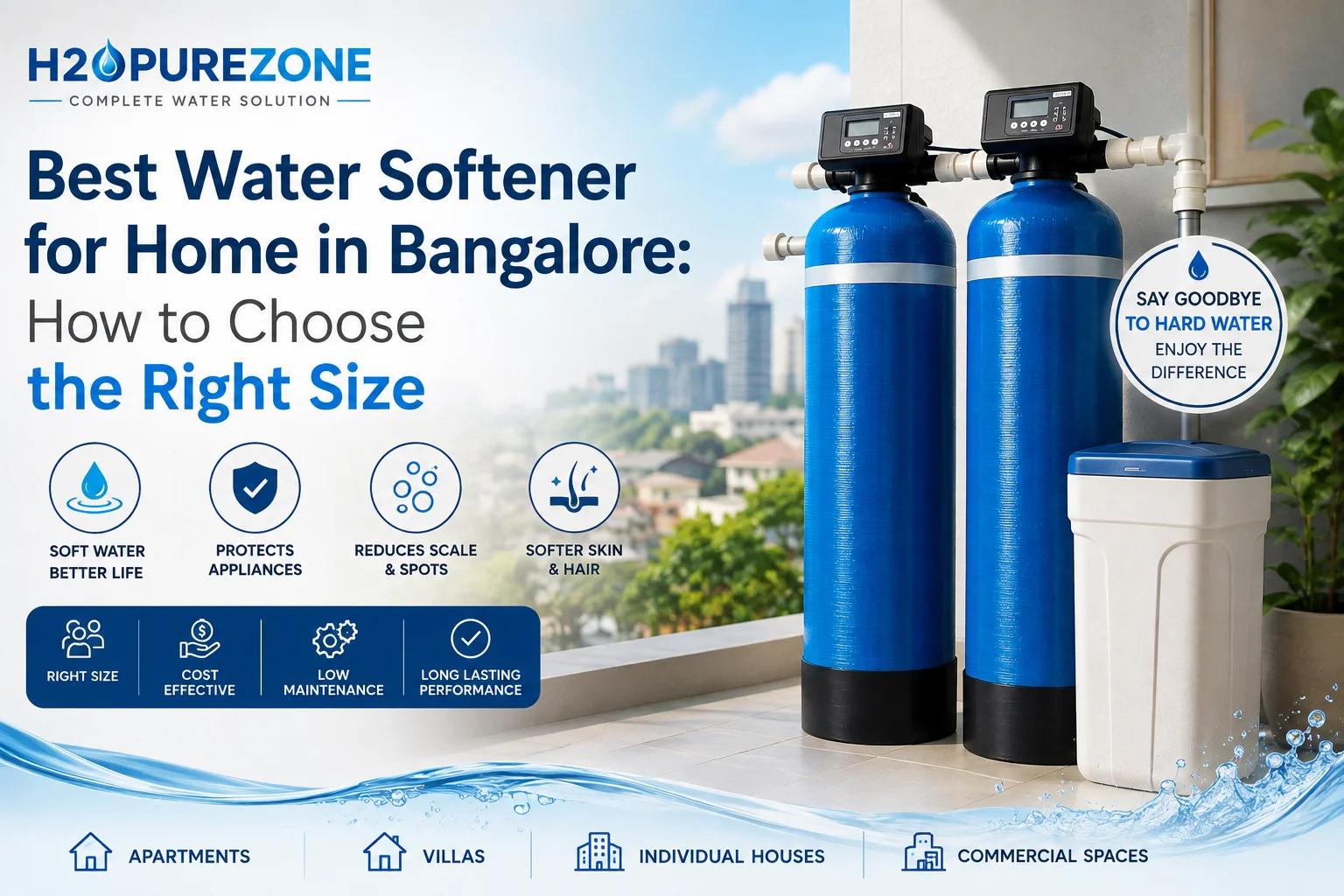
Best Water Softener for Home in Bangalore: How to Choose the Right Size
If you are looking for the best water softener for your home in Bangalore, choosing the right size is just as important as choosing the right technology. A water softener that is too small may regenerate frequently and struggle to meet your household’s demand, while an oversized system can increase the initial investment and may not operate as efficiently as a correctly sized system.
Bangalore homes can receive water from different sources, including municipal supplies, borewells and private tankers. Because water quality and hardness can vary by location and source, the ideal water softener should be selected according to water hardness, daily water consumption, household size and required flow rate rather than simply choosing the biggest available model.
In this guide, we explain how to choose the right water softener for your Bangalore home, what capacity you may need, and what to consider before installation.
Why Do Homes in Bangalore Need a Water Softener?
Hard water contains dissolved minerals, primarily calcium and magnesium. When hard water is repeatedly heated or evaporates from surfaces, these minerals can contribute to scale deposits.
Common signs of hard water include:
- White deposits on bathroom taps and shower fittings
- Scale inside geysers and water heaters
- Reduced efficiency of plumbing fixtures
- Soap that does not lather easily
- Dull or stiff-looking laundry
- Mineral deposits on tiles and glass
- Increased cleaning effort
- Dry or uncomfortable skin after bathing
A water softener uses an ion-exchange process to reduce hardness minerals in the treated water. However, the system needs to be correctly sized for the household to provide consistent performance.
What Is the Best Water Softener for a Bangalore Home?
There is no single water-softener size that is best for every home.
The right system depends mainly on:
- Water hardness
- Daily water consumption
- Number of people
- Number of bathrooms
- Peak flow requirement
- Available installation space
- Desired regeneration frequency
Water-softener capacity refers to the amount of hardness the system can remove before regeneration. It is not simply the physical size of the blue tank.
This is why professional water testing and sizing are recommended before purchasing a system.
Step 1: Test Your Water Hardness
The first step in selecting a water softener in Bangalore is to determine the hardness of your incoming water.
Hardness is commonly expressed as mg/L or ppm as calcium carbonate, or in grains per gallon (gpg). One gpg is approximately equivalent to 17.1 mg/L of calcium carbonate.
For example, two homes in different Bangalore locations may have different water requirements even if both have four family members. If one property receives relatively hard borewell water while another receives a different source, the required softener capacity can be different.
Do not select a water softener based only on the number of people in your home. Test the water first.
Step 2: Calculate Your Daily Water Requirement
The second major factor is how much water your household uses.
Consider:
- Number of family members
- Number of bathrooms
- Frequency of bathing
- Washing-machine usage
- Kitchen and cleaning requirements
- Geyser usage
- Garden or other non-essential water use
- Whether the softener treats the entire house or selected outlets
As household water consumption increases, the softener needs sufficient capacity to handle the additional hardness load.
A useful simplified calculation is:
Daily hardness load = Water hardness × Daily water consumption
The exact engineering calculation should also account for the selected resin, operating conditions, regeneration settings and desired reserve capacity.
Step 3: Choose the Right Capacity
As a general starting point, household requirements can be grouped like this:
| Home Type | Typical Occupancy | Suggested Approach |
|---|---|---|
| 1–2 BHK apartment | 1–3 people | Small/medium capacity after water testing |
| 2–3 BHK home | 3–5 people | Medium capacity based on hardness and usage |
| 3–4 BHK villa | 4–6 people | Medium/high capacity |
| Large villa | 6+ people | High-capacity system |
| Apartment/Multiple bathrooms | Variable | Size according to peak flow and total consumption |
These are only starting points. A published capacity guide similarly emphasizes that family size, daily usage and water hardness must be considered together when selecting a softener.
Why You Shouldn’t Automatically Buy the Largest Softener
A bigger water softener is not automatically better.
An oversized system may cost more initially and may not provide the best operating efficiency for a small household. On the other hand, an undersized softener can exhaust its capacity quickly and require more frequent regeneration.
The goal should be correct sizing, not maximum sizing.
Water Softener for a 2 BHK Apartment in Bangalore
For a typical 2 BHK apartment with a small family, a compact or medium-capacity domestic water softener may be sufficient.
However, the correct choice depends on:
- Actual hardness
- Number of occupants
- Number of bathrooms
- Daily consumption
- Whether the system treats all bathrooms
- Available water pressure
- Whether the water comes from borewell, tanker or another source
If your apartment has particularly hard water or high consumption, a larger capacity may be required.
Water Softener for a 3 BHK or 4 BHK Home
A larger home generally has greater water consumption and potentially more simultaneous water demand.
For a 3 BHK or 4 BHK home, consider:
- Total family size
- Number of bathrooms
- Number of showers
- Geysers
- Washing machines
- Peak water flow
- Total daily water consumption
If multiple bathrooms are likely to be used simultaneously, flow rate becomes especially important. A softener may have adequate hardness-removal capacity but still be unsuitable if its service flow is too low for the home’s peak demand.
Water Softener for Villas in Bangalore
Independent villas often have higher water consumption than apartments.
They may also use:
- Multiple bathrooms
- Multiple geysers
- Large kitchens
- Washing machines
- Dishwashers
- Garden water
- Borewell or tanker water
For these applications, a higher-capacity automatic water softener may be appropriate.
However, garden and other non-essential water outlets do not necessarily need softened water. Separating essential household water from irrigation requirements can help reduce unnecessary softening demand.
Borewell Water and Water Softeners
Borewell water can contain significant levels of hardness depending on the location and source.
If your Bangalore home uses borewell water, test the water before selecting a softener.
A proper assessment should ideally consider:
- Hardness
- TDS
- Iron
- pH
- Turbidity
- Other contaminants relevant to the source
A water softener is primarily designed to address hardness, not every water-quality problem.
If your water has high iron, turbidity or other contaminants, pretreatment may be necessary before the softener.
Automatic vs Manual Water Softener
Another important decision is whether to choose a manual or automatic system.
Manual Water Softener
Manual systems generally require the user or service technician to manage regeneration.
They can be suitable for certain smaller applications where regular manual operation is acceptable.
Automatic Water Softener
Automatic systems can manage regeneration according to programmed settings or water usage, depending on the valve and configuration.
For homeowners looking for convenience, an automatic water softener can be particularly useful because regeneration does not have to be manually managed every time.
The right choice depends on household usage, budget, installation requirements and maintenance preferences.
Why Resin Capacity Matters
The resin inside an ion-exchange water softener is responsible for removing hardness ions from the water.
Over time, the resin becomes loaded with hardness minerals and needs regeneration.
Therefore, when comparing water softeners, don’t look only at:
“How big is the tank?”
Also ask:
- How much resin does it contain?
- What is its effective softening capacity?
- What is the service flow rate?
- How often will it regenerate?
- How much salt does regeneration require?
- How much water is used during regeneration?
- What type of control valve is installed?
These details are more useful than tank dimensions alone.
How Often Does a Water Softener Regenerate?
Regeneration frequency depends on:
- Incoming water hardness
- Household consumption
- Resin capacity
- Salt dosage
- Control-valve programming
- Water usage pattern
An undersized system may regenerate very frequently because its capacity is exhausted quickly.
A properly sized system should be configured according to the actual hardness load and household demand.
What Happens If You Choose the Wrong Size?
Choosing the wrong water-softener capacity can cause several problems.
If the System Is Too Small
You may experience:
- Frequent regeneration
- Higher salt consumption
- Greater water consumption during regeneration
- Hardness breakthrough
- Inconsistent soft-water performance
If the System Is Too Large
You may experience:
- Higher purchase cost
- Underutilized resin capacity
- Inefficient operation if the system is poorly configured
- Longer periods between regeneration than appropriate for the application
Correct sizing is therefore more important than simply choosing the largest available model.
What Is the Best Water Softener for a Family of 4 in Bangalore?
For a family of four, there is no universal answer.
A practical selection process would be:
Family size → Water consumption → Water hardness → Required capacity → Flow rate → Regeneration settings
For example, a family of four using moderately hard water may require a very different system from another family of four using significantly harder borewell water.
This is why a water-hardness test should come before the final product selection.
Water Softener Installation in Bangalore
Professional installation is important because the system needs to be correctly connected to the home’s water supply.
Installation should consider:
- Inlet and outlet connections
- Drain connection
- Bypass arrangement
- Water pressure
- Electrical requirements for automatic valves
- Regeneration discharge
- Installation space
- Accessibility for salt filling and maintenance
The softener should also be positioned where it can be serviced conveniently.
How Much Does a Water Softener Cost in Bangalore?
The water softener price in Bangalore varies depending on the system’s capacity, resin volume, control valve, automation, tank size, installation requirements and application.
Instead of choosing a system purely on price, compare the total value:
Purchase price + installation + salt consumption + water consumption + maintenance + expected service life
A cheaper system may not necessarily be cheaper to operate over several years.
Why Choose H2O Pure Zone for Your Home Water Softener?
Choosing the right water softener is not only about purchasing equipment. Correct water testing, capacity selection, installation and after-sales maintenance are equally important.
H2O Pure Zone can help homeowners evaluate their water-softening requirements and select a solution according to their household’s water conditions and usage.
Whether you live in an apartment, independent house or villa, the objective should be the same:
Test the water → calculate the requirement → choose the right capacity → install correctly → maintain the system.
Frequently Asked Questions
1. Which water softener is best for a home in Bangalore?
The best water softener depends on your water hardness, household consumption, family size and required flow rate. There is no single model that is ideal for every Bangalore home.
2. What size water softener do I need for a family of four?
A medium-capacity system may be suitable for many four-person households, but the final size should be calculated using actual water hardness and consumption.
3. Is a water softener required for borewell water?
Not necessarily in every case, but borewell water can have high hardness. A water test is the best way to determine whether softening is required.
4. Does a water softener remove TDS?
A conventional ion-exchange water softener is designed primarily to reduce hardness caused by calcium and magnesium. It should not be considered a general-purpose TDS-removal system.
5. Does a water softener protect geysers?
Reducing hardness can help reduce mineral-scale formation in water-heating equipment, potentially helping with maintenance and efficiency.
6. How long does a water softener last?
Service life depends on resin quality, water conditions, usage, regeneration settings and maintenance. Regular servicing and correct operation can help maintain performance.
7. Should I buy a manual or automatic water softener?
Automatic systems offer greater convenience, while manual systems can be appropriate where manual regeneration is acceptable. Your water usage and maintenance preferences should guide the choice.
Final Verdict: Choose the Right Size, Not Just the Biggest Size
Finding the best water softener for your home in Bangalore starts with understanding your water.
Don’t select a system simply because it has a larger tank or a lower price. Instead, evaluate:
Water hardness + daily consumption + family size + flow requirement + resin capacity + regeneration requirements.
A correctly sized water softener can provide more consistent soft-water performance while helping you avoid unnecessary salt, water and maintenance costs.
If you are planning to install a water softener in Bangalore, get your water hardness tested and have the system sized according to your actual household requirements.
H2O Pure Zone – Complete Water Solution
For homes, apartments and villas, choose a water-softening solution based on your water—not guesswork.